
Quick takeaway
- Yes, you can add EV charging with little or no upfront cost. Utility and state rebates, plus a charging partner that invests in the project, can cover equipment and installation.
- Level 2 is the right charger for apartments and condos. It adds about 25 miles of range per hour, enough for residents who park overnight.
- You keep the chargers. Under a turnkey model like Poweral’s, the partner runs billing, repairs and driver support for a share of the charging revenue.
- Rebates differ by state and utility. For example, Georgia Power pays multifamily owners $5,000 per Level 2 charger, and PSE&G in New Jersey offers up to $30,000 in on-bill credits.
- The federal 30C tax credit ended June 30, 2026. Guides that still list it are out of date.
Want to know what your property qualifies for? Check your eligibility
Residents who drive EVs want to charge where they live. For apartment and condo owners, the question is not whether to add charging but how to pay for it and who will run it. This guide answers both, with real numbers, so you can decide in one read.
Can you add EV charging to an apartment building without paying for it?
Usually, yes. Most multifamily properties can add EV charging at little or no upfront cost by combining two things: utility and state incentives for your address, and a charging partner that invests its own money to cover what the incentives don’t. With Poweral, installation is typically free to the property owner, the owner keeps the chargers, and Poweral runs them for a share of the charging revenue. You can see how the process works step by step.
That is one of three ways to do it. The right one depends on how much you want to spend and how much work you want your team to take on.
The 3 ways to add EV charging to a multifamily property
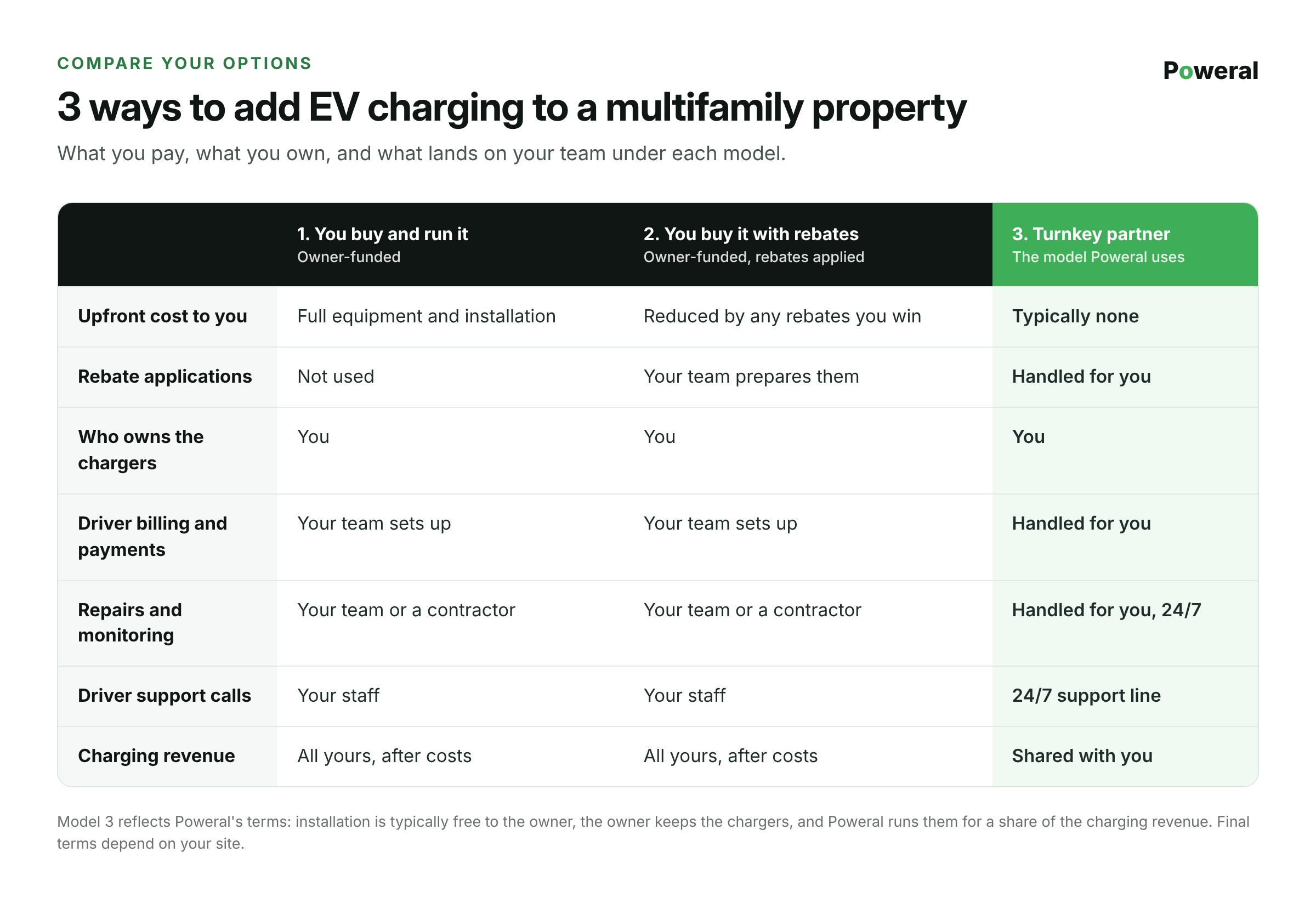
1. You buy and run the chargers
You pay for the equipment and installation, set up driver billing, and handle repairs and driver calls. You keep all charging revenue after costs. This suits owners with capital to spend and a team ready to manage charging day to day.
2. You buy the chargers and apply for rebates
Same as the first model, but your team finds and applies for incentives to lower the cost. Rebate rules differ by utility, often require approval before work starts, and are paid after installation. Our guide to EV charging grants and rebates explains how these programs work.
3. A turnkey partner installs and runs them
The partner handles incentives, installation and long-term management, and shares the charging revenue with you. With Poweral, we handle the rebate applications, installation is typically free to the owner, and you keep the chargers. For a broader look at pricing, see what commercial EV charger installation costs.
How the no-cost model works
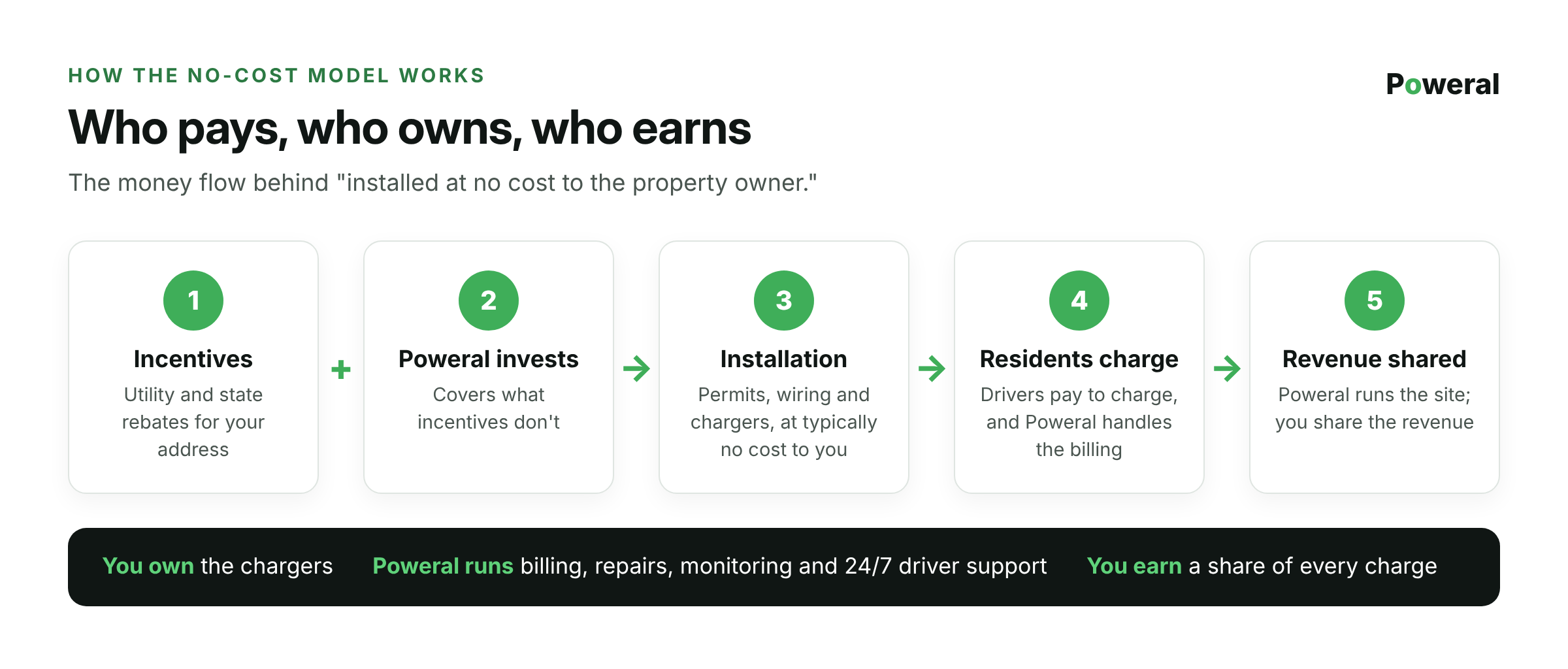
“No cost” is not a trick. Here is where the money comes from and where it goes:
- Incentives: utility and state rebates available for your address cover part of the project.
- Partner investment: Poweral co-invests to cover what incentives don’t.
- Installation: permits, wiring and chargers are completed at typically no cost to you.
- Residents charge: drivers pay to charge, and Poweral handles billing and payments.
- Revenue is shared: Poweral runs the site and you receive a share of the charging revenue.
You own the chargers throughout. Poweral provides ongoing maintenance and support, including 24/7 remote monitoring, software updates, repairs and a 24/7 driver support line, so residents never call your office about a charger.
Which EV chargers are right for apartments and condos?
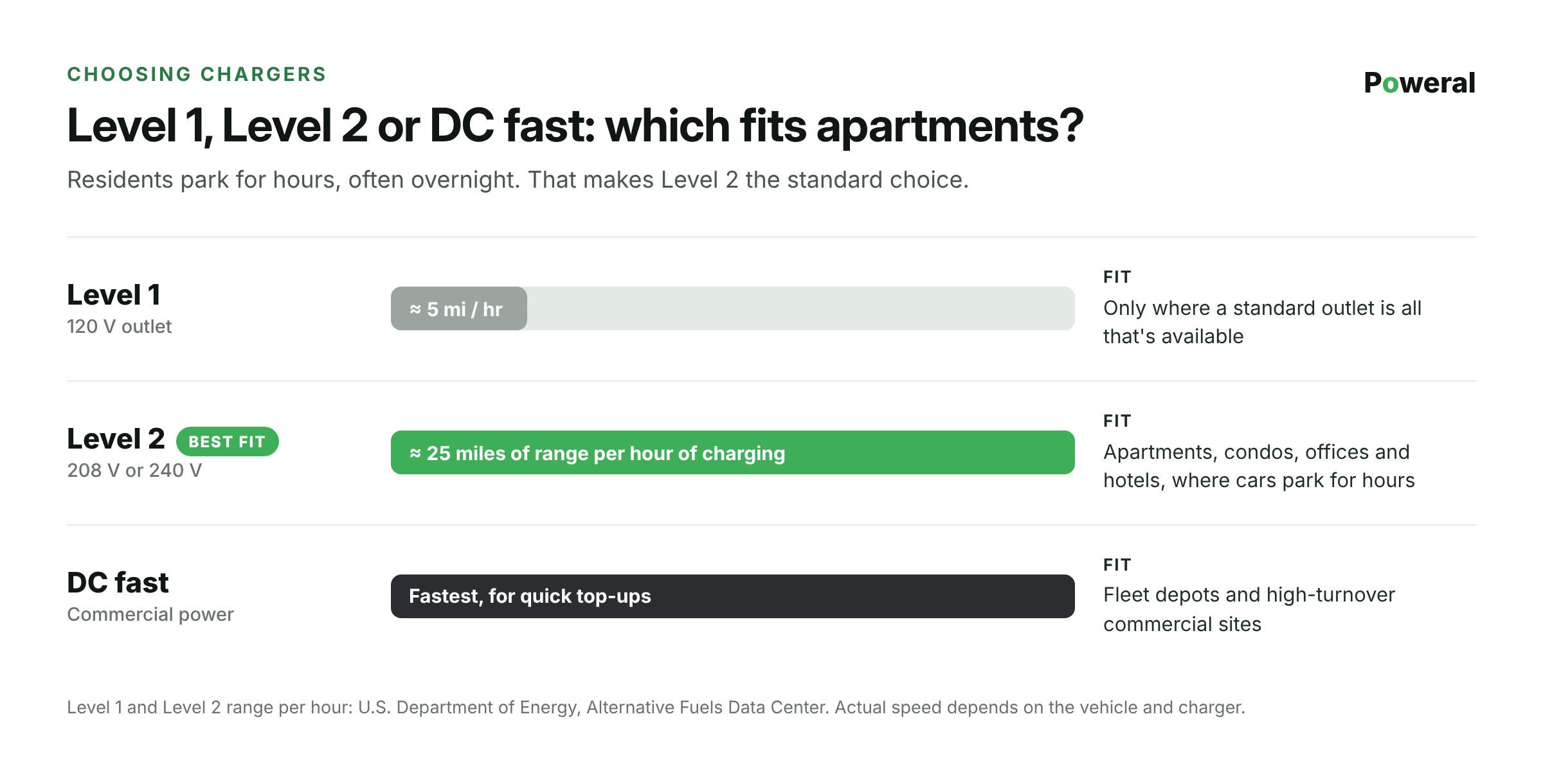
Level 2 is the standard choice for multifamily properties. According to the U.S. Department of Energy, Level 2 charging adds about 25 miles of range per hour, compared with about 5 miles per hour for Level 1. Residents park for hours, often overnight, so Level 2 is enough for daily driving. DC fast chargers are built for quick top-ups at fleet depots and high-turnover sites, which is why they rarely fit apartment parking. Read more on Level 2 vs. Level 3 charging.
The chargers Poweral installs
- Tesla Universal Wall Connector: Level 2, up to 48A, about 44 miles of range per hour, charges Tesla and non-Tesla EVs.
- Autel MaxiCharger A12: Level 2, up to 50A, touchscreen with RFID, app and mobile pay, available with a J1772 or NACS connector.
Both work for Tesla and non-Tesla drivers, so you don’t have to pick one brand for your residents. See our EV charging station installation service for details.
Multifamily EV charging incentives by state (November 2026)
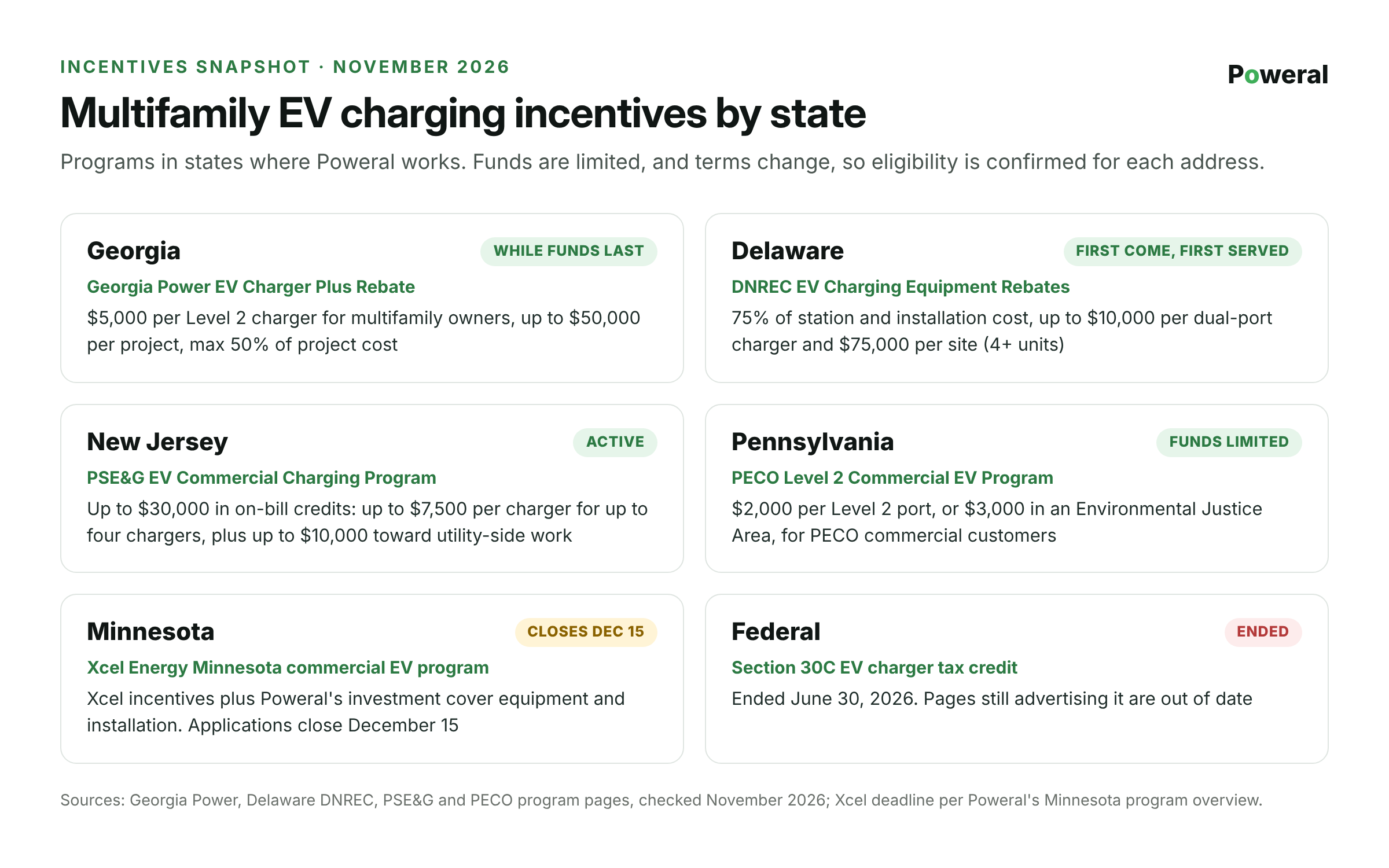
Incentives change often and funds are limited. These are the programs in states where Poweral works, checked against each program’s own page in November 2026.
Georgia
Georgia Power’s EV Charger Plus Rebate pays multifamily owners $5,000 per Level 2 charger, up to $50,000 per project and $150,000 per year, and no more than 50% of project cost. Available while funds last.
Delaware
DNREC rebates cover 75% of station and installation cost for apartments and condos with four or more units, up to $5,000 per single-port charger, $10,000 per dual-port charger and $75,000 per site, from a first-come, first-served $2 million pool. See our Delaware page.
New Jersey
PSE&G’s EV Commercial Charging Program offers up to $30,000 in on-bill credits toward wiring and panel work, up to $7,500 per charger for up to four chargers, plus up to $10,000 toward utility-side work. Multifamily properties apply under its mixed-use commercial program. See our New Jersey page.
Pennsylvania
PECO pays $2,000 per Level 2 port, or $3,000 in a state-designated Environmental Justice Area, to its commercial customers. Funds are limited.
Minnesota
Xcel Energy’s Minnesota commercial EV program, combined with Poweral’s investment, covers equipment and installation. Applications close December 15. See our Minnesota page.
Federal tax credit
The federal Section 30C credit for EV charging equipment ended June 30, 2026. If a guide still lists it as available, that information is out of date.
Poweral also works in Rhode Island, where the state grant program closed in 2021, and in other states across our 14-state service area. We confirm which programs apply to your address during the site assessment. Don’t see your state? Ask us. New programs open often.
Condo and HOA rules: can a board say no?
It depends on the state. New Jersey law limits how much a condo or co-op association can restrict a unit owner from installing a charger in their deeded or assigned space, though associations can still require licensed installation and reasonable standards. Pennsylvania and Delaware have no such law today, so each board sets its own rules. In Pennsylvania, Senate Bill 561 would address EV charging in these communities, but it has not passed.
For boards, installing shared chargers ahead of demand lets you set the rules for placement, cost and licensed installation, instead of handling one resident request at a time.
How to add EV charging to your property in 5 steps
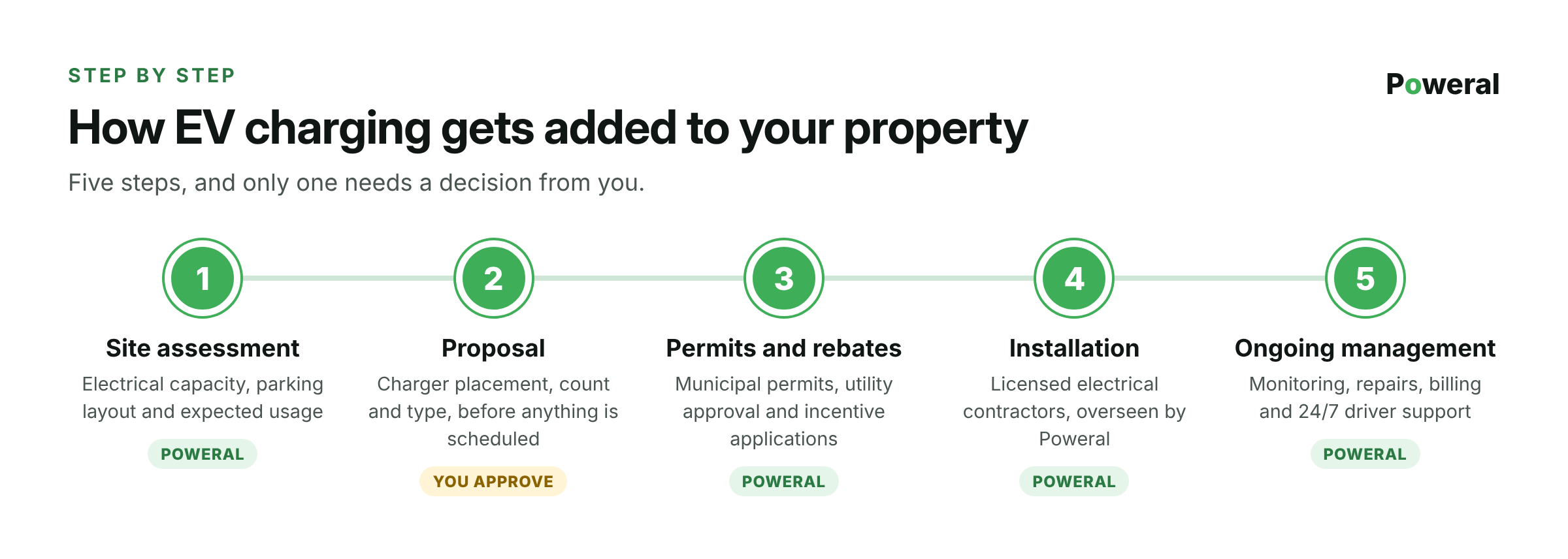
1. Site assessment
We review your electrical capacity, parking layout and expected usage.
2. Proposal
You get a clear plan for charger placement, count and type before anything is scheduled. This is the one step that needs your decision.
3. Permits and rebates
We handle municipal permits, utility approval and incentive applications.
4. Installation
Licensed electrical contractors complete the work, overseen by Poweral.
5. Ongoing management
We monitor the chargers, schedule repairs, handle driver billing and run a 24/7 driver support line.
Want to see the results first? See properties we have completed.
10 questions to ask any EV charging provider
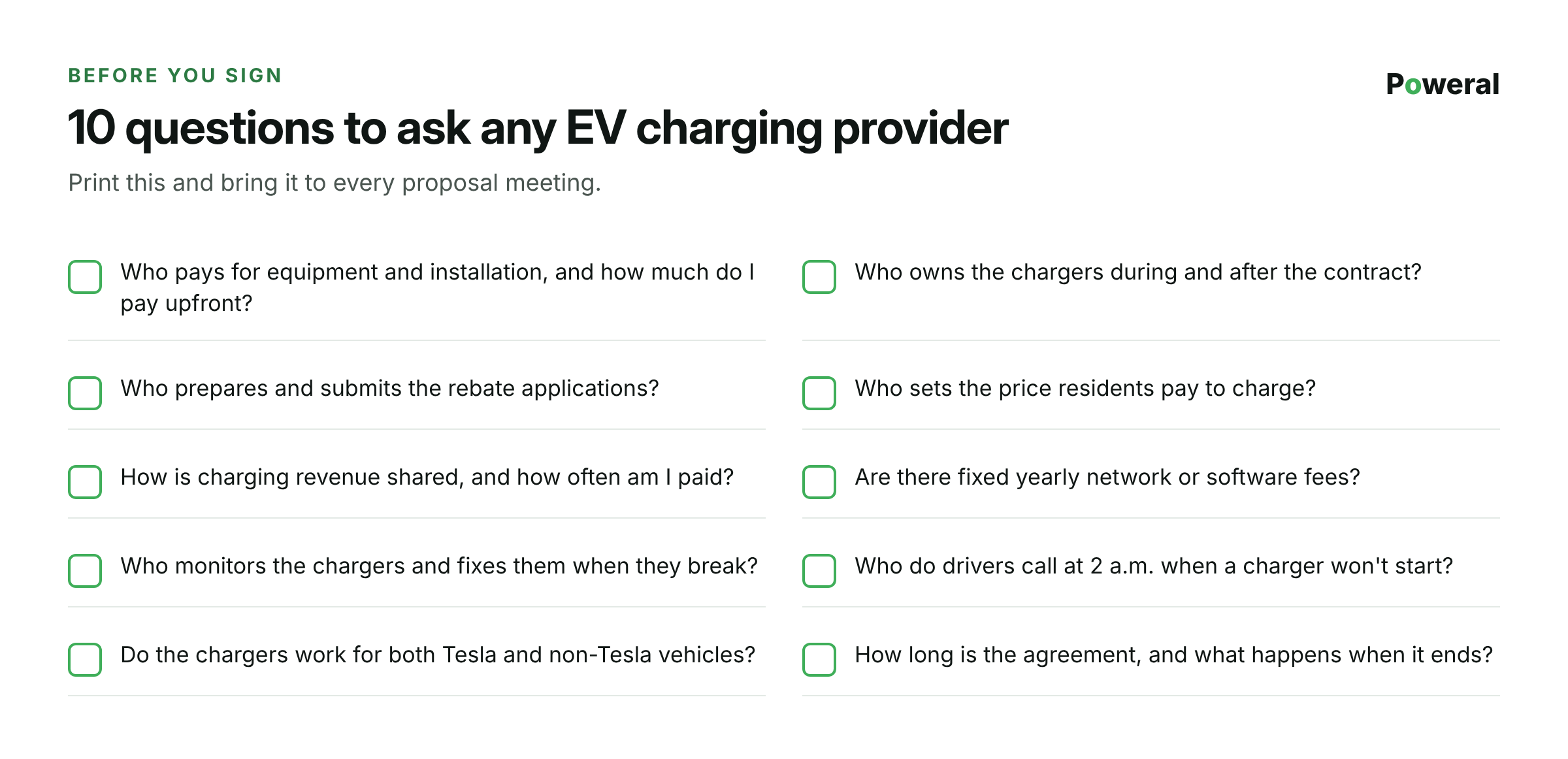
Whoever you talk to, get clear answers to these before you sign. They are the questions that decide what the chargers will really cost you and your team.
- Who pays for equipment and installation, and how much do I pay upfront?
- Who owns the chargers during and after the contract?
- Who prepares and submits the rebate applications?
- Who sets the price residents pay to charge?
- How is charging revenue shared, and how often am I paid?
- Are there fixed yearly network or software fees?
- Who monitors the chargers and fixes them when they break?
- Who do drivers call at 2 a.m. when a charger won’t start?
- Do the chargers work for both Tesla and non-Tesla vehicles?
- How long is the agreement, and what happens when it ends?
Already have chargers that don’t work?
Outdated, offline or broken chargers are common at older installations. Poweral can keep your hardware with a software swap or replace it with new equipment, at minimal to zero cost depending on underwriting, through our Charger Replacement Program.
Live in an apartment and want EV charging?
Residents usually can’t install a charger in shared parking on their own. The fastest route is your property manager or board. Share this guide with them: it shows how they can add charging with little or no upfront cost.
Frequently asked questions
Can EV chargers be installed at an apartment complex at no cost to the owner?
Often, yes. Utility and state incentives plus a charging partner’s investment can cover equipment and installation. With Poweral, installation is typically free to the property owner, and Poweral runs the chargers for a share of the charging revenue.
Who owns the chargers in a no-cost EV charging program?
With Poweral, the property owner keeps the chargers. Poweral manages them, including monitoring, repairs, billing and driver support.
What type of EV charger is best for an apartment building?
Level 2. It adds about 25 miles of range per hour, according to the U.S. Department of Energy, which suits residents who park for hours or overnight.
How do residents pay to charge?
Residents pay per charging session. In Poweral’s model, Poweral handles billing and payment processing, so your staff never collects charging fees.
Who maintains EV chargers at a multifamily property?
In a turnkey model, the charging partner does. Poweral provides 24/7 remote monitoring, software and firmware updates, scheduled repairs and a 24/7 driver support line.
Is there still a federal tax credit for EV chargers?
No. The federal Section 30C credit for EV charging equipment ended June 30, 2026.
Do the chargers work for Tesla and non-Tesla EVs?
Yes. The Tesla Universal Wall Connector charges both, and the Autel MaxiCharger A12 is available with a J1772 or NACS connector.
Does EV charging add value to a multifamily property?
It can make a property more attractive to residents who drive EVs. We cover the evidence in what EV charging does for property value.
See what your property qualifies for
Tell us about your property and we’ll check which incentives apply. We reply within one business day. You can also browse everything Poweral offers or call (718) 587-1515.